DialoguesV · Russell
Why is the chicken most confident the day before?
Win rate, position size and ruin
“The man who has fed the chicken every day throughout its life at last wrings its neck instead.”
In plain words: A long record of good days tells you nothing certain about tomorrow.
Bertrand Russell, The Problems of Philosophy, 1912
Does your strategy win almost every time? Then you really should read this one.
2 · The storyThe chicken had a perfect track record.
Bertrand Russell used a farmyard to explain one of the oldest problems in philosophy: the problem of induction. Every morning the farmer comes, and the chicken is fed. A hundred mornings, a thousand. With every meal the chicken grows more confident. The farmer is reliable, the pattern is clear, tomorrow will be the same.
The chicken is not stupid. It is doing exactly what we all do: learning from experience. Its confidence is at its highest on the last morning of its life.
The pattern was real, Russell pointed out. It was the reason behind it that the chicken had misunderstood. More refined views as to the uniformity of nature, he added drily, would have been useful to the chicken.
3 · The tradeEighty per cent right. Ruined anyway.
Some strategies feel like being fed every morning. Take profits quickly, give losses room to recover. Sell far from the price and collect the that almost always expires worthless. Buy every , because every dip so far has come back.
The record looks wonderful: win, win, win, small loss, win, win. Then comes the day that pays for all the others. And because losses and gains are not symmetrical, that day costs more than it looks. A 50% loss needs a 100% gain just to get back to where you started.
The was never the problem. The size of the losses was, and the size of the that turned one bad day into the last one.
4 · The testThree hundred chickens, two hundred mornings.
Skip the testHow it works. 300 traders follow exactly the same rules for 200 trades, each with different luck. “The 80% trader” wins 80% of trades, making 5% each time, and loses 20%, at 18% each time. Choose an example at the top, then move the position-size slider to bet more or less per trade.
Reading the chart. Each faint line is one account. The dashed line is the expected average: what the rules earn on average in theory, across endless traders. The green line is the typical account: half of the traders do better, half do worse. Watch the gap between the dashed and the green line.
Hypothetical simulation on a log scale. Not trading data and not a forecast.
What it showsOpen it once you have tried the test
The average can be strongly positive while the typical account loses most of its money. A few lucky accounts pull the average up; most accounts are the chicken. Now press “Same, half size”: the same rules, with smaller swings, can turn ruin into slow growth.
Two Nobel prizes do not make a stop-loss.
Long-Term Capital Management was a run by celebrated traders, with two Nobel laureates in economics among its partners. For years it earned steady returns with strategies that won small and often. In 1998, within a few months, it lost about 4.6 billion dollars, and a group of banks had to rescue it under the eye of the US Federal Reserve.Lowenstein, When Genius Failed, 2000.
The models were clever. The chicken was well educated. It was still a chicken.
Aristotle had already described the cure, two thousand years earlier: courage, he wrote, is the mean between cowardice and recklessness.Aristotle, Nicomachean Ethics, Book II. That is what the slider above measures.
6 · The fixBe the farmer, not the chicken.
The farmer knows something the chicken does not: the reason behind the pattern.
- Ask what you are being paid for. If a strategy wins often, find out what risk it is quietly collecting a premium for. Small, frequent gains are often the price of a rare, large loss.
- Size for the worst day, not the average one. Choose your from the loss you could take on the day the pattern breaks, not from your win rate.
- Find the mean. Too small and nothing grows; too large and one bad day ends it. Somewhere in between, the typical account stops losing. Find that point before the market finds it for you.
Find your worst day.
Look up your largest single loss and divide it by your average win. The answer is how many good mornings one bad one cancels. Write it somewhere you will see it before every trade.
Send us your win rate and your losses.
ask@socratrades.com
No more carrier pigeons. The last one panicked at the first red candle and sold the letter at a loss.
Free. Answered in writing by real people; Socratrades is a character. General answers only: we don’t assess your situation or name instruments. Never published without your yes.A high win rate says nothing about the size of the losses. In this simulation, 300 accounts win 80% of trades at +5% and lose 20% at −18%. The expected value is positive, yet at too large a size the typical account loses, and a smaller size changes that. Long-Term Capital Management, with two Nobel laureates among its partners, lost about 4.6 billion dollars in 1998.
Three questions readers ask
Can you lose money with a high win rate?
Yes. Win rate counts how often you win, not how much. With wins of 5% and losses of 18%, one loss erases more than three wins.
Why does position size matter so much?
It decides what one bad day costs. In this page’s simulation, a smaller size turns ruin into slow growth for the typical account, with the same rules.
What does Russell’s chicken have to do with trading?
The chicken grows more confident with every meal, until the day the farmer comes for it. A long run of good days says nothing certain about tomorrow.
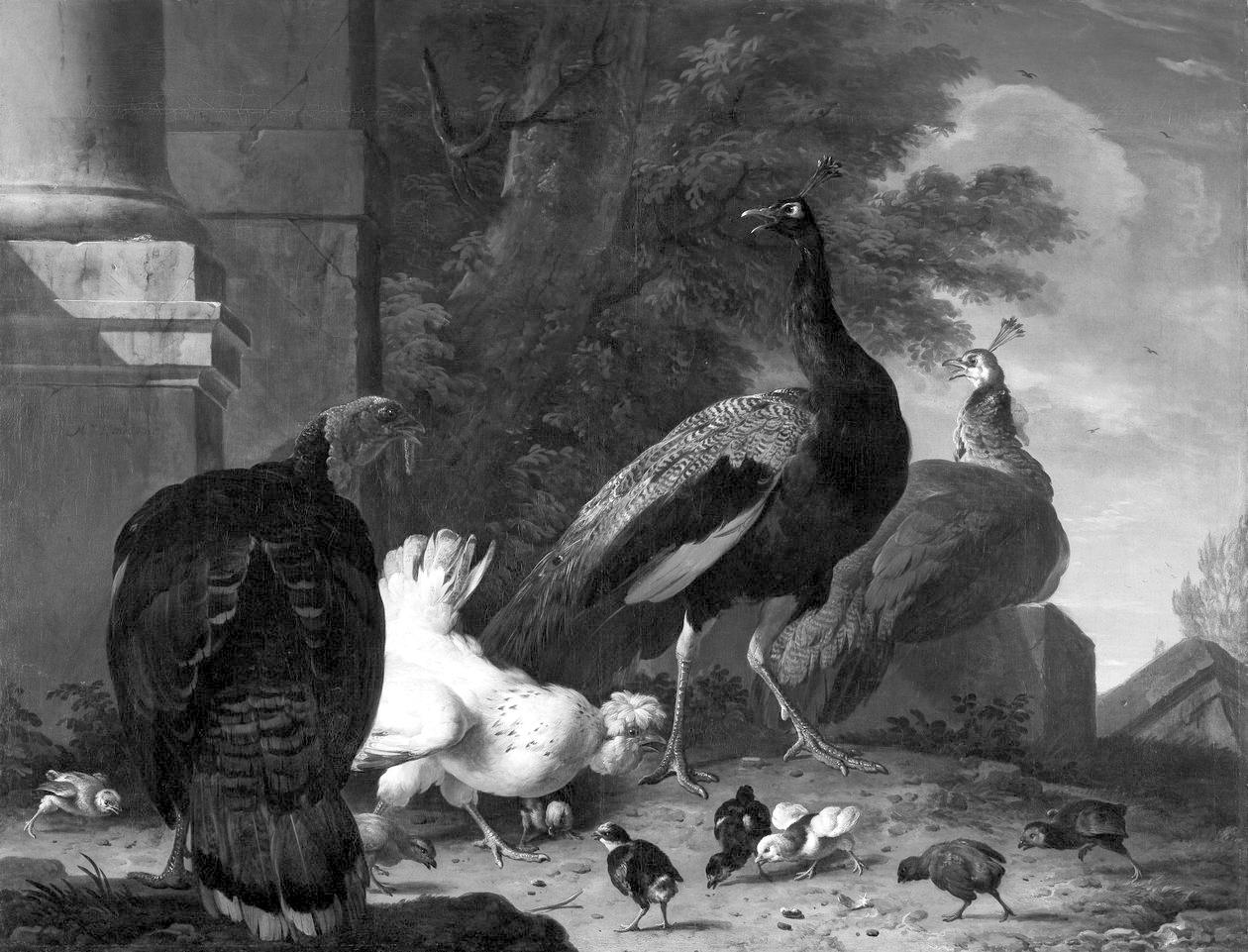
Painting: Melchior d’Hondecoeter, A Hen with Peacocks and a Turkey, c. 1680. Rijksmuseum, Amsterdam. Public domain.