DialoguesXI · Laozi
Why are the loudest traders the least worth following?
Trading gurus and edited track records
“Those who know do not speak. Those who speak do not know.”
In plain words: Those who really know tend to say little. Those who say a lot often know little.
Laozi, Tao Te Ching, chapter 56, in a common English rendering
Do you follow anyone who is very, very sure about where the market is going?
2 · The storyThe sage who had to be asked.
The most quoted sage in China did not want to write anything down. A border guard made him.
Laozi, “the Old Master”, is said to have lived in China in the sixth century BC and kept the archives of the royal court. Whether he was one real person is still debated. The book attributed to him, the Tao Te Ching, certainly exists, and it has been translated more often than almost any other.
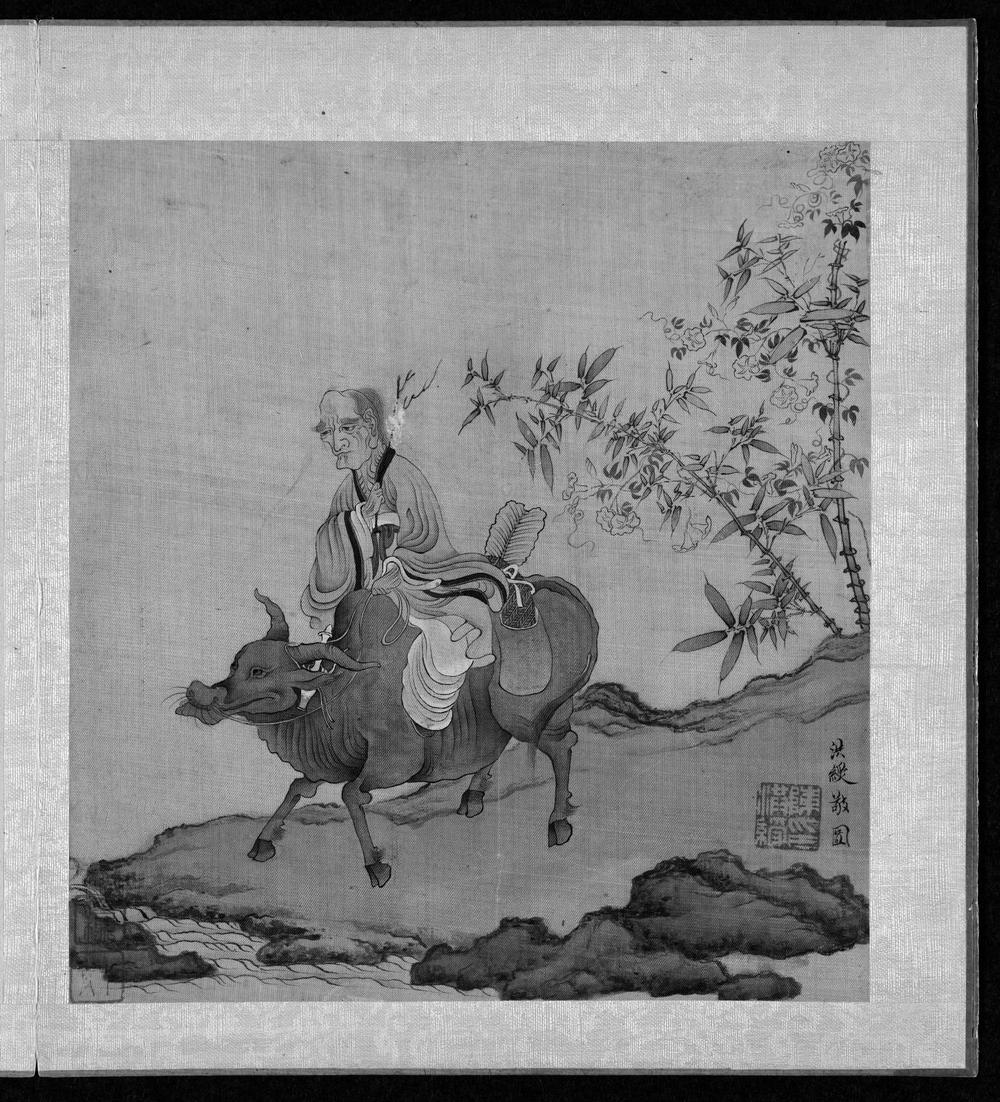
The legend goes like this. Weary of the court’s decline, Laozi left for the west. At the pass, the gatekeeper recognised him and would not let him through until he had written down his wisdom. Laozi wrote about five thousand characters, handed them over and went on his way.Sima Qian, Records of the Grand Historian, c. 94 BC. He was never seen again. The ox arrived later: the oldest account does not mention it, but painters liked it, and it stayed.
The wisest man of his age did not look for an audience. He had to be stopped at a border and asked. Compare that with your feed.
3 · The tradeThe loudest record is the most edited.
Social media runs on the opposite principle. Certainty gets followers; doubt gets ignored. A trader who says “I don’t know where the market goes” gathers a few hundred followers. A trader who called the last crash gathers hundreds of thousands, even if he has also called twenty crashes that never came.
The loud record is not necessarily a lie. It is usually an edit. The losing calls are deleted, the blown-up accounts go quiet, and what remains looks like insight. Add a course, a signal group or a paid community, and the reason to keep editing is clear.
Following someone feels like a shortcut: their knowledge, your money. In practice it is often the reverse.
4 · The testWho would you follow?
Skip the testHow it works. Three trading accounts, invented for this test but built from patterns you will recognise. Choose the one you would follow. Then see the full record behind each of them.
What it showsOpen it once you have tried the test
The loudest accounts are usually the most edited. The quiet one is the only one showing everything, which is exactly why it is quiet.
The famous experts were the least accurate.
The political scientist Philip Tetlock spent about two decades collecting forecasts from nearly three hundred experts. On average they did little better than chance. And the experts who appeared most often in the media tended to be among the least accurate.Tetlock, Expert Political Judgment, Princeton University Press, 2005.
Tetlock borrowed an ancient Greek line to describe the difference: “The fox knows many things, but the hedgehog knows one big thing.” Hedgehogs, with one big confident theory, made worse forecasts than foxes, who doubted and adjusted. Guess which of the two gets invited back on television.
6 · The fixAsk for the whole record.
Yes, this includes this website. That is why socratrades makes no predictions and recommends nothing.
- Demand the full record. Every call, with dates, including the wrong ones. If someone cannot show it, you are looking at a highlight reel.
- Ask how they are paid. A person paid by followers, subscriptions or signals is paid for attention, not for accuracy.
- Prefer “I don’t know”. The person who admits uncertainty is usually the one who has actually measured it.
Audit one guru.
Pick one account you follow. Find every call it made over three months, losers included. If you cannot find the losers, you have found your answer.
Ask how to check a record. No names needed.
ask@socratrades.com
No more carrier pigeons. The last one panicked at the first red candle and sold the letter at a loss.
Free. Answered in writing by real people; Socratrades is a character. General answers only: we don’t assess your situation or name instruments. Never published without your yes.Public trading track records are usually edited: losing calls are deleted, and failed accounts go quiet. Philip Tetlock collected forecasts from 284 experts over about two decades. On average they did little better than chance, and the most media-visible were among the least accurate (Expert Political Judgment, 2005). Ask for the complete, dated record, losses included.
Three questions readers ask
Are trading gurus worth following?
socratrades recommends no one, itself included. Without the complete, dated record, you are looking at a highlight reel.
How can I check a trader’s track record?
Ask for every call with dates, including the wrong ones, how many others tried the same thing, and how the person is paid.
Are expert forecasts accurate?
Tetlock’s 284 experts did, on average, little better than chance over two decades, and the most media-visible were among the least accurate.
Painting: Chen Hongshou, Laozi Riding an Ox, from Paintings after Ancient Masters, 17th century. The Cleveland Museum of Art. CC0.