“It is perfectly true, as the philosophers say, that life must be understood backwards. But they forget the other proposition, that it must be lived forwards.”
In plain words: Looking back, life makes sense. Living it, you never have the full picture.
Søren Kierkegaard, journal entry, 1843 (Papirer IV A 164), in its most widely quoted English translation
Have you ever looked at an old chart and thought: it was so obvious?
2 · The storyThe man who walked Copenhagen.
Kierkegaard published under a small crowd of invented names and let them disagree in print. If you have ever argued with your own trading journal, you know the method.
He spent most of his short life in Copenhagen, walking the streets and quarrelling with nearly everyone. He is often called the father of existentialism: the philosophy of the individual who has to choose without certainty.
In his journal in 1843 he wrote down a thought that sounds simple and is not: life must be understood backwards, but it must be lived forwards. Looking back, a life seems to have a shape. Events lead to events, decisions make sense, the story has a direction. But we never live it that way. We live at the front edge, choosing without knowing what comes next.
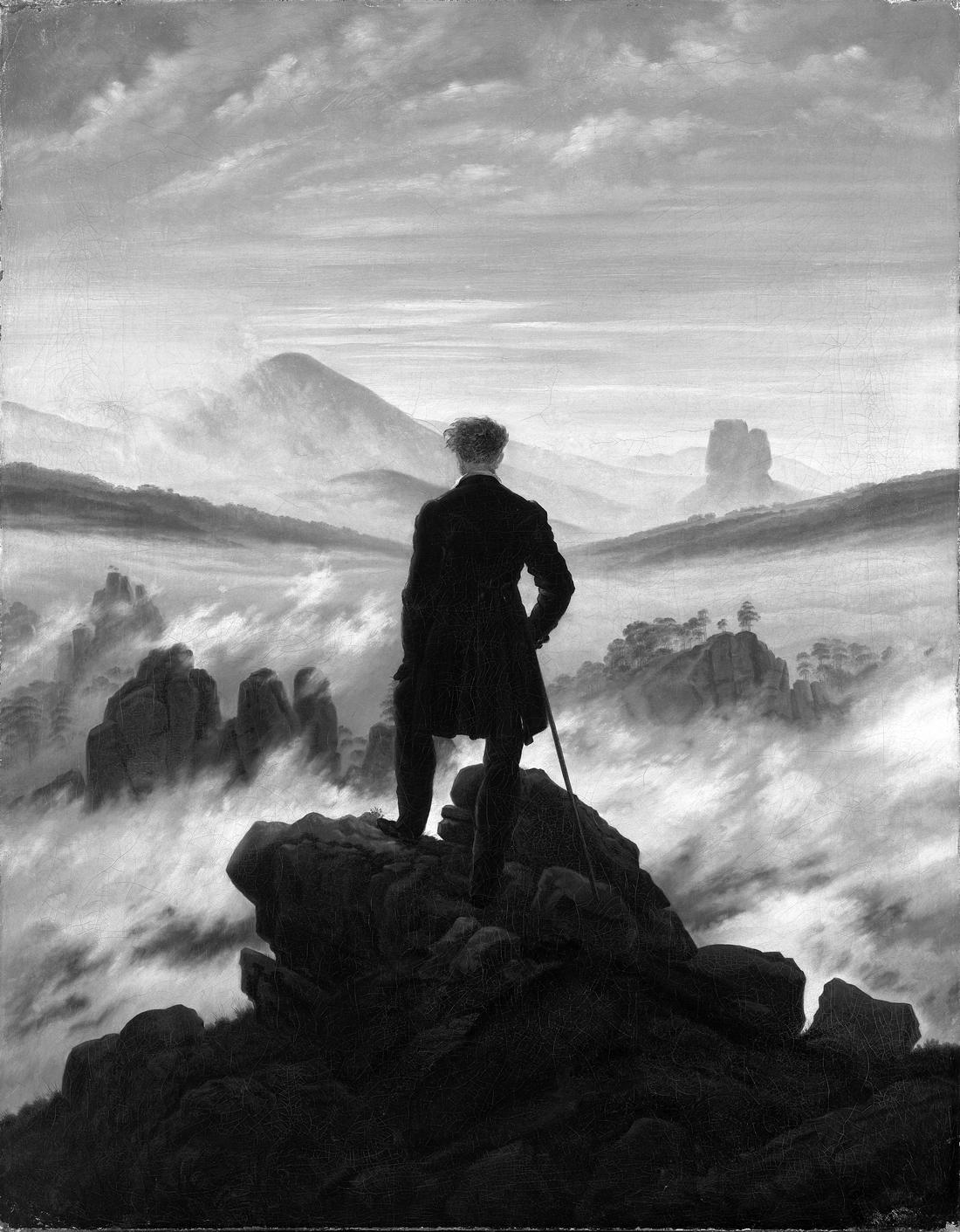
Caspar David Friedrich had painted the feeling a few decades earlier: a man above a sea of fog. Behind him, the path he climbed is clear. Ahead, almost nothing.
3 · The tradeThe crash was obvious. Afterwards.
Look at any chart of the past and the story writes itself. Here the bubble formed. Here the warning signs appeared. Here, obviously, was the top. Anyone could have seen it.
Except that nobody could, at the time. At the time, the same chart was a fog of possibilities, and the warning signs were mixed in with a hundred false alarms that led nowhere. Hindsight keeps the signals that worked and quietly throws the rest away.
This matters, because hindsight does not stay in the past. If the past looks obvious, the future starts to look predictable too. And a trader who believes the future is predictable trades bigger, sizes more confidently and learns the wrong lesson from every loss. Not “I could not have known”, but “I should have known”.
4 · The testCall the chart.
Skip the testHow it works. The chart shows a price up to “today”, the dotted line. Decide whether the price will be higher or lower fifty days later, say how sure you are, and press Reveal. You can play as many charts as you like.
What it showsOpen it once you have tried the test
Every chart here is generated by chance: each day is a coin toss, so there is nothing to predict. Yet once you see the ending, it looks natural, almost obvious. That feeling, that you could have known, is hindsight. It appears even when there was nothing to know.
We remember knowing what we did not know.
Before President Nixon’s trips to China and the Soviet Union in 1972, the psychologists Baruch Fischhoff and Ruth Beyth asked students how likely various outcomes were. After the trips, they asked the same students to recall their original estimates. The students remembered having given higher odds to the events that had actually happened.Fischhoff and Beyth, “I knew it would happen”, Organizational Behavior and Human Performance, 1975.
Fischhoff called this creeping determinism: once we know an outcome, it seems to have been inevitable all along. Our memory does not just forget. It edits.
6 · The fixWrite it down before the fog lifts.
The only defence against an editing memory is a record it cannot touch.
- Keep a decision diary. Before each trade, write what you expect, why, and how sure you are. Date it. Never edit it afterwards.
- Review the diary, not the chart. When you look back, compare what happened with what you wrote down, not with what you now remember thinking.
- Ask the forward question. After a loss, ask what you could have known at the time, not what you know now. “Could I have known?” is a better question than “Why didn’t I see it?”
Start a decision diary.
Before your next five trades, write three lines: what you expect, why, and how sure you are. Date them. Read them only once the trade is closed.
Send us the trade you “should have seen”.
ask@socratrades.com
Carrier pigeons are no longer used. Too many of them followed the flock.
Free. Answered in writing by real people; Socratrades is a character. General answers only: we don’t assess your situation or name instruments. Never published without your yes.Hindsight bias is the feeling, once an outcome is known, that it was predictable all along. Fischhoff and Beyth (1975) asked students to forecast the outcomes of Nixon’s 1972 trips, then to recall their forecasts. They remembered having given higher odds to what actually happened. For traders, the remedy is a dated decision diary, written before each trade and never edited.
Three questions readers ask
What is hindsight bias?
The feeling, once an outcome is known, that it was obvious all along. Fischhoff called it creeping determinism.
Could anyone have predicted the crash?
Afterwards the warning signs look clear. At the time, they were mixed in with many false alarms that led nowhere.
How does a trading journal help?
A dated note written before each trade (what you expect, why, how sure you are) is a record your memory cannot rewrite.
Painting: Caspar David Friedrich, Wanderer above the Sea of Fog, c. 1818. Hamburger Kunsthalle. Public domain.