“The quickest runner can never overtake the slowest, since the pursuer must first reach the point whence the pursued started.”
In plain words: If you measure the race from where you started, you never seem to arrive.
Zeno’s paradox, as reported by Aristotle, Physics, Book VI, 239b, translated by R. P. Hardie and R. K. Gaye
Ever promised to sell “as soon as I’m back to even”? Or traded bigger straight after a loss, to win it back by lunch?
2 · The storyThe fastest man in Greece loses to a tortoise.
Zeno of Elea lived in the fifth century BC and specialised in arguments that seemed airtight and could not possibly be true. The most famous is a race. Achilles, the fastest runner in Greek myth, gives a tortoise a head start.
By the time Achilles reaches the point where the tortoise started, it has moved on a little. By the time he reaches that new point, it has moved on again. However fast he runs, there is always a little distance left. So, Zeno concluded, Achilles never catches the tortoise.
In real life, of course, Achilles passes it in seconds. The trick lies in how Zeno cuts up the race: into ever smaller pieces, each measured from the tortoise’s last . It took mathematicians around two thousand years to explain properly how infinitely many pieces can add up to a finite distance.
Zeno’s own book is lost. We know his paradoxes mainly through Aristotle, who quoted them in order to refute them. Being remembered mainly through your critics: also a fate familiar to many traders.
3 · The tradeBreakeven is the tortoise.
A losing position creates its own finish line: the price you paid. From that moment on, you measure everything against it. Every rally that brings the price closer feels like progress. You promise yourself to sell the moment you are back to even.
The market does not know that line exists. Only you do. And the line runs away from you faster than it looks, because a loss and the gain needed to repair it are not the same size. A 20% loss needs a 25% gain. A 50% loss needs 100%.
So the waiting becomes the strategy. Money sits in an old position you would not buy today, while better ideas pass by. And when the price finally does come back to your entry? Most people sell exactly there, with relief, at the one price that means nothing to the market at all.
The fast version has a name: revenge trading. Waiting for is the slow way to chase the tortoise. The fast way looks like this. A loss at 10:40. By 10:45 you are in the next trade: bigger, without a , because the only goal left is to make the morning’s number disappear. If that one loses too, the next is bigger still.
Each trade feels like correcting a mistake. Each one is a new mistake, sized by anger rather than by your rules. A revenge day tends to end in one of two ways: back at zero, exhausted and convinced it was skill, or with the loss that ends the account. Zeno would have recognised the method. Every race is measured from the last loss.
4 · The testMeasure the distance to breakeven.
Skip the testHow it works. Drag the slider to choose the size of a loss. The red bar is the loss, the green bar the gain you would need to get back to breakeven. Below, how long that would take at 7% a year, a hypothetical rate chosen only for illustration.
The 7% a year is a hypothetical rate for illustration, not a forecast.
What it showsOpen it once you have tried the test
The gain you need grows much faster than the loss. Beyond a loss of about 30%, breakeven stops being a plan and becomes a hope with a long horizon.
After a loss, we gamble to get even.
Richard Thaler and Eric Johnson found that people who had just lost money were drawn to bets that offered a chance to break even, bets they would otherwise have refused.Thaler and Johnson, “Gambling with the House Money and Trying to Break Even”, Management Science, 1990. The goal quietly changes from making a good decision to erasing a bad one.
Professionals are not immune. Joshua Coval and Tyler Shumway studied full-time traders at the Chicago Board of Trade. Those who had lost money in the morning took on more risk in the afternoon.Coval and Shumway, “Do Behavioral Biases Affect Prices?”, Journal of Finance, 2005. Revenge trading, with a membership card.
Racecourses show the same thing. Studies of horse racing found that bettors put more money on long shots in the last race of the day, when most of them are behind and one lucky win could still save the afternoon.McGlothlin, “Stability of choices among uncertain alternatives”, American Journal of Psychology, 1956.
The finance professor Hersh Shefrin gave the condition a name that needs no translation: get-evenitis.Shefrin, Beyond Greed and Fear, Harvard Business School Press, 2000.
6 · The fixStop racing the tortoise.
Achilles only wins once he stops measuring the race from the tortoise.
- Forget the entry price. Look at the position as if you had just been handed it. Decide from today’s price, today’s facts and today’s alternatives.
- Never sell “at breakeven”. If your plan says sell, sell. If it says hold, hold. Your is the one number your plan should never mention.
- After a loss, wait. Set a cooling-off rule before you need it: after a losing trade, no new trade for thirty minutes; after two, none until tomorrow. The next trade must be one your plan would take anyway, at the size it says.
- Cap the loss before it needs a miracle. Decide in advance the loss at which you close, while the way back is still a plan and not a prayer.
Thirty minutes after a loss.
For one week, after every losing trade, set a 30-minute timer before the next one. When it rings, ask: would my plan take this trade, at this size, if the last one had won?
Tell us about the position you are waiting on, or your last revenge day.
ask@socratrades.com
We retired the carrier pigeons. One kept flying back to its entry price.
Free. Answered in writing by real people; Socratrades is a character. General answers only: we don’t assess your situation or name instruments. Never published without your yes.Anchoring to breakeven turns the entry price into a finish line, although the market ignores it. Losses need larger gains to repair: 20% needs 25%, and 50% needs 100%. After a loss, people accept bets they would otherwise refuse (Thaler and Johnson, 1990), and traders who lose in the morning take more risk in the afternoon (Coval and Shumway, 2005). Decide from today’s price.
Three questions readers ask
What is the break-even effect?
After a loss, people are drawn to choices that offer a chance of getting back to even, including bets they would otherwise refuse (Thaler and Johnson, 1990).
What is revenge trading?
Trading again straight after a loss, usually bigger and without a setup, to win the money back. Coval and Shumway found that professional traders who lost money in the morning took on more risk in the afternoon.
How much do I need to gain to recover a loss?
The loss divided by one minus the loss: 10% needs about 11%, 20% needs 25%, 30% needs about 43%, and 50% needs 100%.
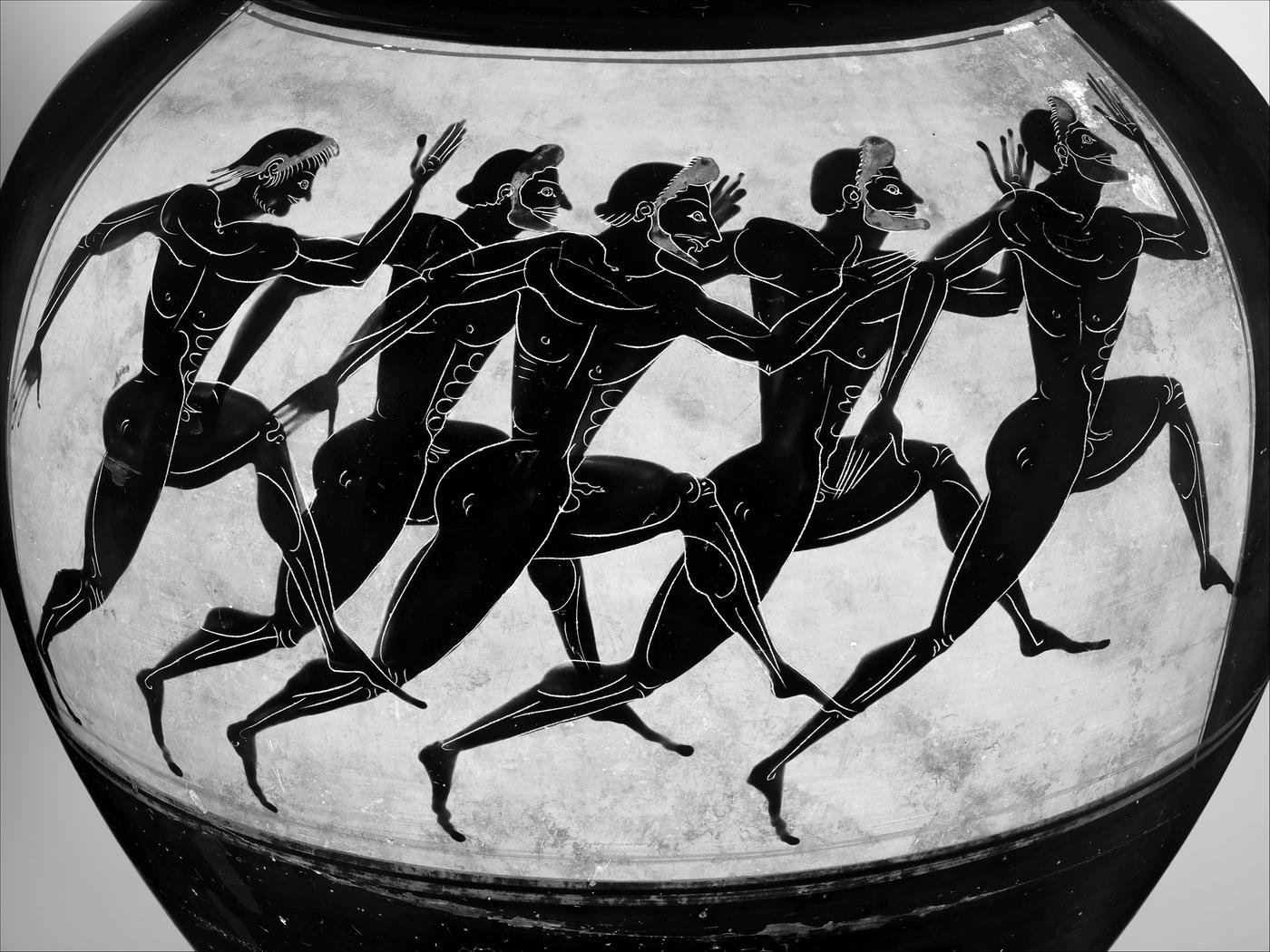
Painting: Attributed to the Euphiletos Painter, Panathenaic prize amphora with a footrace (detail), c. 530 BC. The Metropolitan Museum of Art. Public domain.